

The van was parked outside his sister’s house in Lemon Grove, California. The date was a Wednesday. The time was 10:30 in the morning. The year was 1967. The man inside was 35, a drifter from Vermont who had spent twenty years painting cars and giving guitar lessons to whoever would pay him. He was hiding.
His sister Irene kept talking about the Lord. She had been at it all morning. He couldn’t take it anymore. So he walked outside and sat in his van. Alone. Silent. And then, for reasons he could never explain, he started repeating a prayer he’d never said before: “Jesus, I’m a sinner. Please come into my heart.”
He said it for twenty minutes. Tears ran down his face.
That prayer led to a hot air balloon. The balloon led to a broken sewing machine in Nebraska. The sewing machine led to fourteen years of stitching fabric scraps. The fabric led to rot. The rot led to a pile of adobe in the California desert. The adobe led to a mountain.
The mountain led to a war.
The Slabs and the Stranger
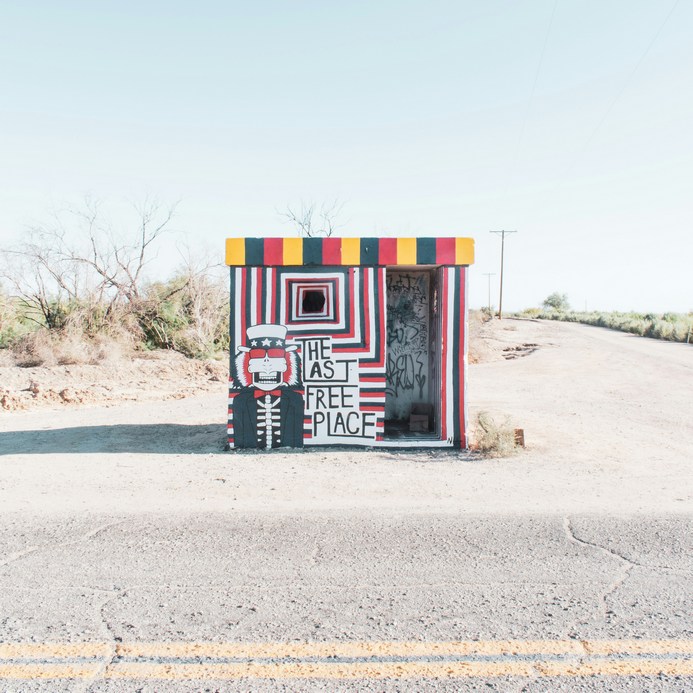
Slab City sits below sea level in the Sonoran Desert, about 150 miles east of San Diego. The temperature exceeds 100 degrees on an average of 122 days per year. Summer highs reach 120 degrees Fahrenheit. There is no running water. No electricity. No law enforcement on site. The population swells to 4,000 in winter and shrinks to 150 in summer.
The name comes from concrete slabs. Camp Dunlap, a U.S. Marine Corps training base, opened on October 15, 1942. Over 185,000 troops trained there during World War II. The Marine Corps closed it in December 1945. By 1956, all buildings had been dismantled. Only the slabs remained.
On October 6, 1961, the Department of Defense conveyed the land back to California by quitclaim deed. No restrictions. No recapture clause.
Veterans who’d worked the base were the first to return. Then drifters. Then RV owners looking for free camping. Then a man with a failed balloon and a bucket of adobe.
The First Mountain That Fell
In 1984, Leonard Knight was changing tires on big-rig trucks in Quartzsite, Arizona. He traveled to Niland with his boss one weekend. He liked the area. It wasn’t as cold as Nebraska or Vermont.
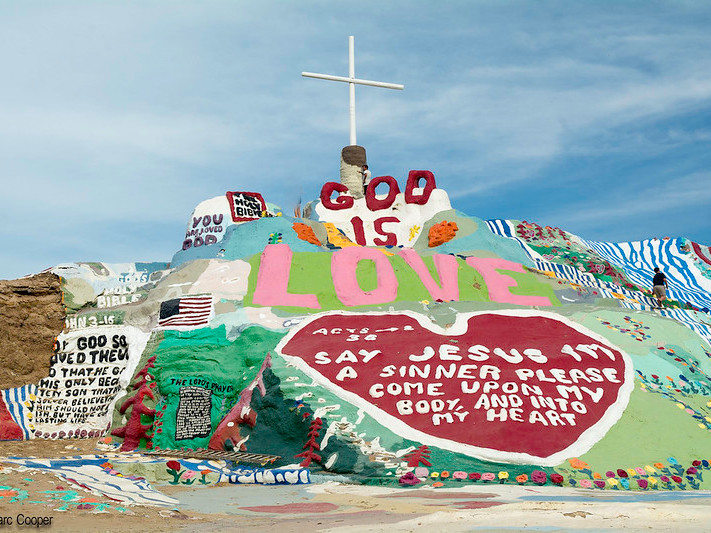
He had spent years sewing a massive hot air balloon in Nebraska, stitching “God Is Love” into patchwork fabric. After fourteen years, the fabric had rotted and torn. The balloon would never fly.
He planned to stay one week. To build a small cement monument. An eight-foot balloon. A statement.
The cement balloon collapsed. Too much water in the mix. Another failure. But this time, something was different. Leonard didn’t leave. He started digging.
Armed with a bucket, a shovel, and half a bag of cement, he began to build what would become Salvation Mountain. Adobe mixed with straw. Paint scraped from half-empty cans at the dump. “I used to spend half a day at the dump to find half a gallon of paint,” he said, “of which only half was usable.”
The first mountain took four years. Then rain came. A crack formed. The whole thing slid down the hillside.
He built it again.
The County That Wanted a Campground
By 1994, Salvation Mountain stood at the entrance to Slab City. Fifty feet tall. A hundred feet wide. Painted flowers and waterfalls and the words “God Is Love” in letters you could see from the highway.
Imperial County supervisors noticed. They wanted to turn Slab City into a fee-based campground. But there was a problem. A religious monument stood at the entrance. They couldn’t charge admission to county land if a church sat on it.
In July 1994, the county hired a toxic waste specialist. Soil samples were taken from twelve holes around the mountain. Before the results came back, they cordoned off the area and labeled it a “toxic nightmare.”
The tests showed high levels of lead contamination. The county petitioned the state for funds to bulldoze the mountain and haul it to a toxic waste dump in Nevada.
Leonard didn’t leave.
He dug soil samples from the same twelve holes. He had them tested at an independent lab in San Diego. The results came back negative. No unacceptable levels of any contaminants. No lead.
The story made the L.A. Times. Leonard got more publicity than he ever dreamed possible. The bulldozers never came.
The Rest of the Story
Leonard Knight lived in the back of his truck at the base of his mountain for twenty-seven years. No electricity. No running water. No air conditioning. Summer temperatures reached 120 degrees. He woke at 5:30 a.m. to paint. He greeted every visitor with a tour and a thumbs-up.
In 2000, the Folk Art Society of America declared Salvation Mountain “a folk art site worthy of preservation and protection.” In 2002, California Senator Barbara Boxer entered it into the Congressional Record as “a national treasure, profoundly strange and beautifully accessible.”
By 2013, the mountain was attracting 200 visitors a day.
Leonard’s hearing and eyesight began to fail in 2010. In December 2011, he moved to a care facility east of San Diego. He realized he was never going to live at his mountain again. He started to let go.
He died on February 10, 2014. He was 82.
The mountain he built required over 100,000 gallons of paint. It has no blueprints. No engineering. No funding. No patron. It was made by a man who dropped out of tenth grade, stuttered as a kid, and spent twenty minutes crying alone in a van.
The van belonged to a man hiding from a sermon. The mountain belongs to everyone who stopped running.
Trail Note: Slab City is located east of Niland, California, accessible via Beal Road. There are no services. Bring water. At least five gallons per day per person. Salvation Mountain is maintained by Salvation Mountain, Inc., a 501(c)(3) nonprofit staffed by volunteers. Donations of paint are accepted. Entry is free.
References
“Slab City Reaches Its Boiling Point.” Bluedot Living, February 17, 2025, bluedotliving.com.
“Biography of Leonard Knight.” Salvation Mountain Official Site, salvationmountain.us/bio.html.
“Slab City: Exploring the History of an Abandoned Military Facility.” DesertUSA, June 8, 2023, desertusa.com.
A note on The Outpost: This publication reconstructs historical events from verified archival, institutional, and primary sources where available. Atmospheric and scenic details are drawn from period records where available and from historical context where noted. Specific temperatures, weather conditions, and scene-setting details included for narrative purposes are grounded in documented historical context but should not be read as verbatim archival record. All named individuals, dates, and documented events are sourced in the reference list above. The Outpost is narrative journalism, not academic history. But it holds itself to the facts that matter.