

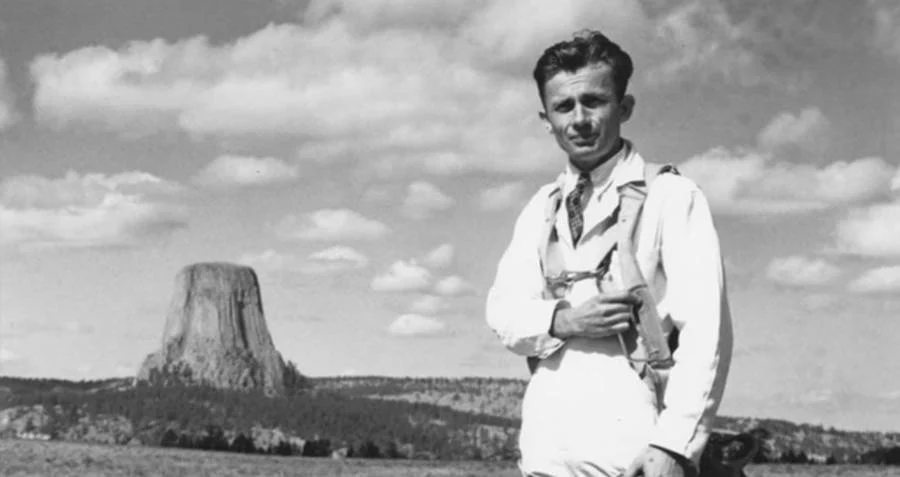
The morning of October 1, 1941, broke cold and clear over northeastern Wyoming. Ground winds were doing 35 miles an hour. A two-passenger plane was circling 800 feet above a volcanic rock formation that had been sitting in that field for 50 million years, minding its own business.
The man in the passenger seat had 2,347 jumps in his logbook. He had bailed out of burning planes for MGM Studios. He had taught the Royal Air Force to parachute and flown supply runs over the English Channel during the evacuation of Dunkirk. He had jumped from 26,400 feet on a delayed pull. He was 29 years old, five-foot-four, 115 pounds, and operated on a personal philosophy best summarized in his own words: “I had always wanted to hit the impossible.”
He did not ask permission. Nobody had.
He jumped at 8 a.m.
The bet came out of a conversation in Rapid City, South Dakota, sometime in mid-1941. On one side of it was a man who kept a live rattlesnake under his hat. Literally. Earl Brockelsby, founder of Black Hills Reptile Gardens, would end tourist tours by removing his cowboy hat to reveal a rattlesnake coiled on top of his head. He had been doing this since he was 19. It had worked out fine every time. He was the kind of man who bet $50 on things that couldn’t be done.
George Hopkins was the kind of man who took those bets.
The deal was simple: land on top of Devils Tower. The summit is roughly the size of a football field. From the ground, it looks like the tip of a thumb. From 800 feet up and 100 feet to the side, in a 35-mph wind, it looks considerably smaller. Hopkins partially collapsed his chute on the way down to check his drift. He slammed onto the rock, grabbed a boulder to keep from being blown off the edge, and collapsed the chute the rest of the way.
He had won the bet. He had also, in the same moment, created the problem that would occupy every newspaper in America for the next six days.
The plan to get down had seemed reasonable on paper. A sledgehammer, a Ford axle sharpened at one end, a hayloft pulley, and two strands of rope. Hopkins would hammer the axle into the rock, thread the pulley, and lower himself hand over hand to the ground. The pilot, Joe Quinn, would drop the kit from the plane.
Quinn came back an hour later and dropped it.
It bounced off the edge of the tower and disappeared.
And it turned out not to matter, because even if it had landed, the rope was 200 feet too short.
Hopkins was not going anywhere.
The villain of this story is a bundle of rope tumbling into empty Wyoming air. It took the decision out of everybody’s hands. What followed was a six-day national spectacle that unfolded like someone had fed the script to a novelist and told him not to be reasonable about it.
The Park Service was notified. Superintendent Newell Joyner, the same man who had spent a decade turning an ignored rock formation into a tourist destination, was now managing a crisis on top of it. His first call was for professional climbers. His second call, it was reported, went to Igor Sikorsky himself, asking about experimental helicopter availability.
Letters and telegrams arrived at the monument from across the country with suggestions. Shoot a rope up with a cannon. Lasso him from a plane. The Goodyear Company offered the use of a blimp. The Navy offered a helicopter. Both were assessed and rejected. The blimp would take three days to reach Wyoming. The helicopter was experimental and the updrafts unpredictable.
Spectators arrived by the hundreds, then thousands. Local motels ran out of rooms. Grocery stores restocked and restocked again. A plane carrying a load of photographers circled the Tower continuously.
Down below, a car equipped with a bullhorn was parked at the base so officials could communicate upward. Hopkins occasionally responded by throwing notes off the edge. One of them read: “I do not want to be rescued by mountaineers. I’m not a mountaineer. I got up here by air and I’m going to get down by air.”
They dropped him a medium-rare steak anyway. And a bearskin suit. And a blanket. And, after he requested it for what he described as “medicinal purposes,” a bottle of whiskey.
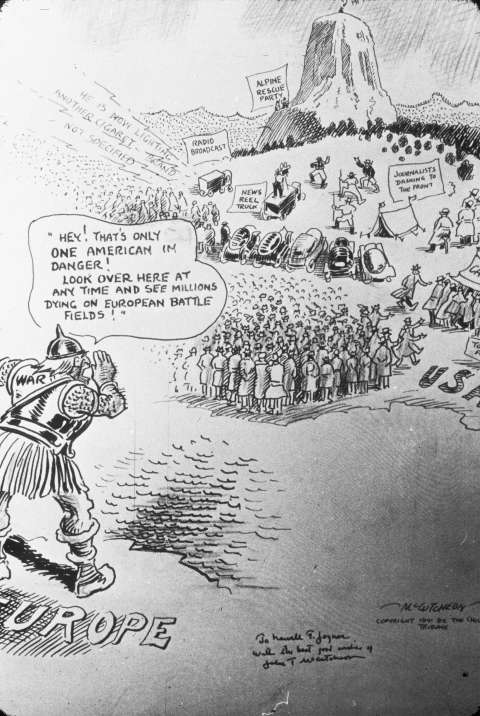
A Chicago Tribune cartoonist drew him into the news cycle as a symbol of American distraction. Hitler controlled nearly all of Europe. Pearl Harbor was eight weeks away. And the country was transfixed by one man on a rock in Wyoming, eating a dropped steak, drinking whiskey, and apparently naming the boulders around him with words he told reporters afterward “you couldn’t print.”
Jack Durrance telegraphed from Dartmouth that he was coming to help. He was 29. He was a medical student, a skier, and one of the few people alive who had already climbed Devils Tower, having pioneered a new route up it in 1938. The year after that, he had been on an American team attempting K2 in the Himalayas.
His plane was grounded by weather. He took a train to Denver. He picked up his brother-in-law and two other climbers in Colorado and drove north. They covered 250 miles under police escort through the night, arriving at the monument at midnight on day five, with sirens and lights.
By then an ice storm had moved through. The Tower was, in the words of climber Harold Rapp, “nothing but a sheet of glass.”
They waited for dawn.
On the morning of day six, October 6, Durrance led eight climbers up a column of frozen phonolite porphyry (the type of rock Devil’s Tower is made of). It took several hours. When they pulled themselves onto the summit, they found Hopkins in good physical condition and excellent spirits, which the whiskey had probably assisted.
Paul Petzoldt looked at him and said: “Well, George, we hear you got up here by air and want to get down by air. You’ve got ten seconds to make a decision because we want to get down off this thing. It’s cold as ice.”
Hopkins said: “For God’s sake, come and get me.”
Durrance gave him a quick lesson in rappelling. They started down at 4:45 p.m. Spectators below lit them up with spotlights. Nine people descended in the gathering dark to an audience of 7,000. When Hopkins’s feet touched the ground, he walked toward the cameras and said he wanted a shave and a haircut.
Then he found Brockelsby in the crowd. “I had my hand out fishin’ for the dough when I hit the ground,” he said. “Earl paid off.”
Six weeks later, Japan bombed Pearl Harbor. Hopkins joined the Army and became a parachute instructor, then went to work for the Office of Strategic Services devising drops behind enemy lines. Brockelsby shipped to Europe. Durrance went back to Dartmouth and eventually became a physician. The Tower stood where it had always stood.
Hopkins married after the war, raised children, continued doing air shows until 1958, then became an engineer for a construction firm in California. Nobody knows exactly when he died. There are too many people named George Hopkins in the records to sort it out.
He is still the only person to have parachuted onto the summit of Devils Tower. The Park Service has made certain of that.
Trail Note: Devils Tower National Monument is located off Wyoming Highway 24 near Hulett, Wyoming, open year-round. Entry is $25 per vehicle. The Tower Trail circles the base in 1.3 miles. The visitor center built by the CCC in the 1930s is still standing. Durrance’s route up the Tower is still the most commonly used by climbers. The summit remains off-limits to everyone else. nps.gov/deto
References
- Dotterer, Abby. “A Stuntman’s Jump: Parachutist Stranded for Days on Devils Tower.” WyoHistory.org, Wyoming Historical Society, July 23, 2019. wyohistory.org
- “Wyoming History: A Parachuter Once Got Stuck Five Days on Top of Devils Tower to Win $50 Bet.” Cowboy State Daily, September 21, 2024. cowboystatedaily.com
- Mattison, Ray H. “True Tales from the National Parks: Get Me Off Devils Tower.” National Parks Traveler, November 7, 2009. nationalparkstraveler.org
- “Two Stories from On Belay.” ClimbAZ.com. climbaz.com
- “Reptile Gardens: Our History.” reptilegardens.com
A note on The Outpost: This publication reconstructs historical events from verified archival, institutional, and primary sources where available. Atmospheric and scenic details are drawn from period records where available and from historical context where noted. Specific temperatures, weather conditions, and scene-setting details included for narrative purposes are grounded in documented historical context but should not be read as verbatim archival record. All named individuals, dates, and documented events are sourced in the reference list above. The Outpost is narrative journalism, not academic history. But it holds itself to the facts that matter.
← Previous: The Man Who Ran America’s Parks Without Anyone Knowing | Next: The River That Ate Men Whole →